
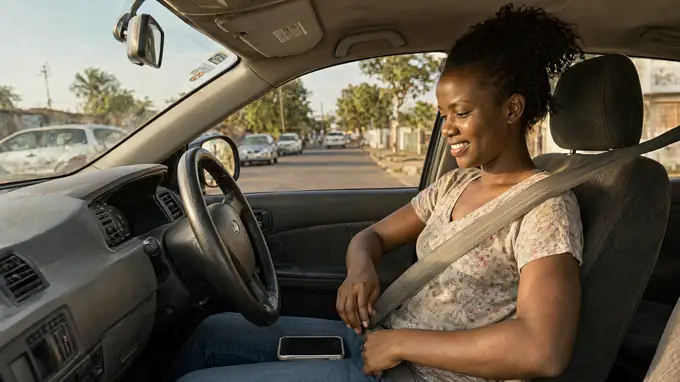
Saturday, a cousin's wedding in Matola. Everyone raises a glass and someone tells you: «Just one little beer, it won't hurt.» It will. Alcohol makes you slower to react and, at the same time, more confident than you should be. That is why the Road Code does not stop at a ban: it gives exact numbers to measure the alcohol in your body, in your breath (exhaled air) or in your blood.
The rule
Driving under the influence of alcohol or drugs (psychotropic substances) is prohibited.
What the Code says (art. 81, n.º 2)
«É proibido conduzir sob influência de álcool ou de substâncias psicotrópicas.» (Portuguese original)
The rule
For an ordinary driver, the law considers you under the influence from 0.3 mg/l in the breath test, or 0.6 mg/l in a blood test.
What the Code says (art. 81, n.º 3)
«Considera-se sob influência de álcool o condutor que apresente uma taxa de álcool igual ou superior a 0,3 mg/l, no teste de ar expirado, ou de 0,6 mg/l, em teste sanguíneo.» (Portuguese original)
The rule
Anyone driving public service transport or dangerous goods, while on duty, has a limit of 0.0 mg/l: not a single sip.
What the Code says (art. 81, n.º 4)
«Para o condutor de transporte de serviço público ou de transporte de carga perigosa, quando em exercício, a taxa de álcool quer no teste de ar expirado, quer no teste sanguíneo é de 0,0 mg/l.» (Portuguese original)
The rule
Carrying alcoholic drinks in the part of the car reserved for passengers is also prohibited.
What the Code says (art. 81, n.º 1)
«É proibido o porte e transporte de bebidas alcoólicas ou de substâncias psicotrópicas na parte reservada aos passageiros em veículos automóveis.» (Portuguese original)

SituationYou drive a fuel tanker (dangerous goods) and at lunch you drink just one beer before going back on the road.
What you doYou cannot. When transporting dangerous goods on duty, the permitted level is 0.0 mg/l, so any alcohol at all is already an offence. art. 81, n.º 4
Remember
- Ordinary driver: under the influence from 0.3 mg/l in the breath or 0.6 mg/l in the blood.
- Public service or dangerous goods, on duty: 0.0 mg/l.
- Drugs at the wheel: prohibited, just like alcohol.
- Alcoholic drinks do not travel in the passenger area.
- 0.3 is not a target: the only level with no doubts is zero.

Check what you've learnt
2 quick questions. Choose and see straight away if you got it right.
Tomás, a private driver, takes the breath test and shows 0.3 mg/l. In the eyes of the law, he is:
Question 1See the answer
A — From 0.3 mg/l in exhaled air (equal or higher) the driver is considered under the influence (art. 81(3)).
What alcohol level is permitted for someone driving dangerous goods transport, on duty?
Question 2See the answer
B — On public service or dangerous goods duty, the level is 0.0 mg/l (art. 81(4)).