
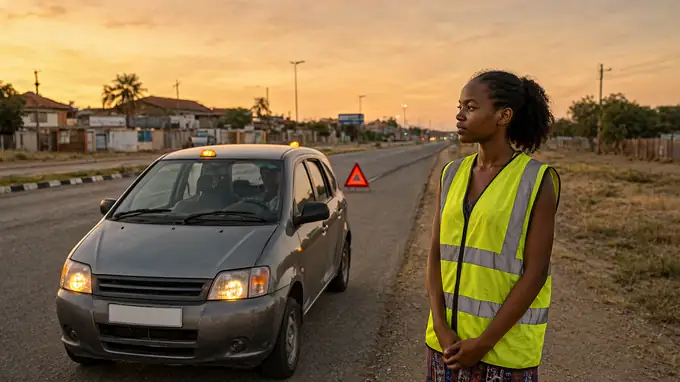
Your car has several lights and each one has a job. Some are there so that you can see the road (dipped headlights and full beam). Others are there so that others can see you and understand what you are going to do: sidelights, indicators, brake light (it comes on when you press the brake), reversing light, number plate light and fog light. And then there are the hazard lights, the famous «four indicators».
The rule
Full beam (driving light) lights up the road ahead over a distance of no less than 100 m.
What the Code says (art. 60, n.º 1)
«Luz de estrada (máximos), destinada a iluminar a via para a frente do veículo numa distância não inferior a 100 m» (Portuguese original)
The rule
Dipped headlights (passing light) light up the road ahead up to 30 m.
What the Code says (art. 60, n.º 1)
«Luz de cruzamento (médios), destinada a iluminar a via para a frente do veículo numa distância até 30 m» (Portuguese original)
The rule
Position lights show the car's presence and width, from the front and from behind; the front ones are called «sidelights».
What the Code says (art. 60, n.º 1)
«Luzes de presença, destinadas a assinalar a presença e a largura do veículo, quando visto de frente e da retaguarda, tomando as da frente a designação de «mínimos»» (Portuguese original)
The rule
The hazard lights are all the indicators flashing at the same time and they warn that your car is a special danger to others.
What the Code says (art. 60, n.º 1)
«constituídas pelo funcionamento simultâneo de todos os indicadores de mudança de direcção» (Portuguese original)
The rule
It is forbidden to have a red light or reflector facing forwards, or a white one facing backwards — except, for example, the reversing light and the number plate light.
What the Code says (art. 59, n.º 2)
«É proibida a utilização de luz ou reflector vermelho dirigidos para a frente ou de luz ou reflector branco dirigidos para a retaguarda» (Portuguese original)

Remember
- Full beam: lights up at least 100 m.
- Dipped headlights: light up to 30 m.
- Sidelights = the front position lights.
- Hazard lights = all the indicators at the same time.
- No red light facing forwards and no white light facing backwards (except reversing and number plate lights).

Check what you've learnt
2 quick questions. Choose and see straight away if you got it right.
How far do dipped headlights reach?
Question 1See the answer
A — The passing light lights up the road ahead up to 30 m (art. 60(1)(b)).
Which white light may face backwards?
Question 2See the answer
B — The reversing light and the number plate light are exceptions (art. 59(2)(a)).