
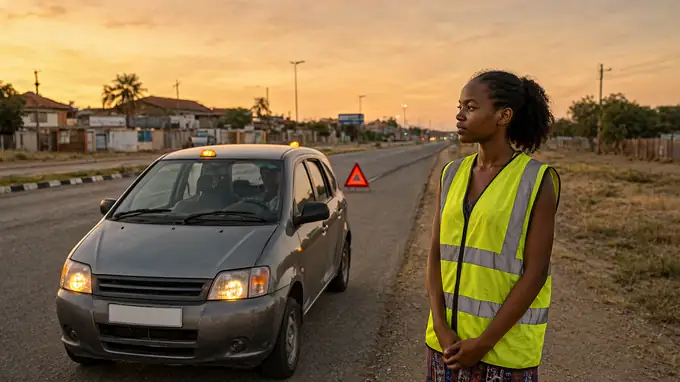
Sometimes a bulb blows halfway through a journey. The Code does not let you carry on as if nothing had happened: with faulty lights, you may only drive the minimum needed to reach a place to stop. And the four indicators are not for «parking for just a minute» in a double line — they are for warning of a real danger.
The rule
With faulty lights, if you only have the hazard lights, you may only drive for the time strictly necessary to reach a place to stop or park.
What the Code says (art. 62, n.º 2)
«Luzes de perigo, caso em que apenas podem transitar pelo tempo estritamente necessário à sua circulação até um lugar de paragem ou estacionamento» (Portuguese original)
The rule
If your lights fail on a motorway or a road reserved for cars and motorcycles, you must halt the car immediately off the carriageway.
What the Code says (art. 62, n.º 3)
«A avaria nas luzes, quando ocorre em auto-estrada ou via reservada à automóveis e motociclos, impõe a imediata imobilização do veículo fora da faixa de rodagem» (Portuguese original)
The rule
Switch on the hazard lights when you have to slow down suddenly because of an unexpected obstacle or bad weather.
What the Code says (art. 63, n.º 2)
«em caso de súbita redução da velocidade provocada por obstáculo imprevisto ou por condições meteorológicas ou ambientais especiais» (Portuguese original)
The rule
Also switch on the hazard lights, if they work, when the car is halted by an accident or breakdown and is a danger to others, and when you are being towed.
What the Code says (art. 63, n.º 3)
«Em caso de imobilização forçada do veículo por acidente ou avaria, sempre que o mesmo represente um perigo para os demais utentes da via» (Portuguese original)
The rule
If the hazard lights do not work in these cases, use the position lights.
What the Code says (art. 63, n.º 4)
«devem ser usadas luzes de presença, se não for possível a utilização das luzes de perigo» (Portuguese original)
SituationYou are on the road to Ponta do Ouro and, after a bend, you see a cow lying on the road. You brake hard.
What you doSwitch on the hazard lights straight away while you slow down: it is a sudden reduction in speed because of an unexpected obstacle, and anyone coming behind needs to realise that you are braking hard. art. 63, n.º 2
Remember
- Only hazard lights working: only as far as the nearest place to stop.
- Faulty lights on a motorway: stop immediately off the carriageway.
- Four indicators: sudden braking, a halted car that is a danger, a car being towed.
- Hazard lights not working? Use the position lights.

Check what you've learnt
2 quick questions. Choose and see straight away if you got it right.
Your car's lights fail on a motorway. What do you do?
Question 1See the answer
B — It requires the vehicle to be halted immediately off the carriageway (art. 62(3)).
Your car is being towed and the hazard lights do not work. Which lights do you use?
Question 2See the answer
B — If the hazard lights cannot be used, the position lights are used (art. 63(4)).