You hear a siren on Av. Eduardo Mondlane and see an ambulance stuck in traffic. It is a priority vehicle: if necessary, it may disregard the rules and signs. But it cannot do everything, and you have a role too: making way for it.
The rule
Priority vehicles are those on an urgent emergency mission and government motorcades, as long as they signal that they are coming.
What the Code says (art. 15, n.º 3)
«Consideram-se veículos prioritários os que transitam em missão urgente de socorro e comitivas governamentais, assinalando adequadamente a sua marcha.» (Portuguese original)
The rule
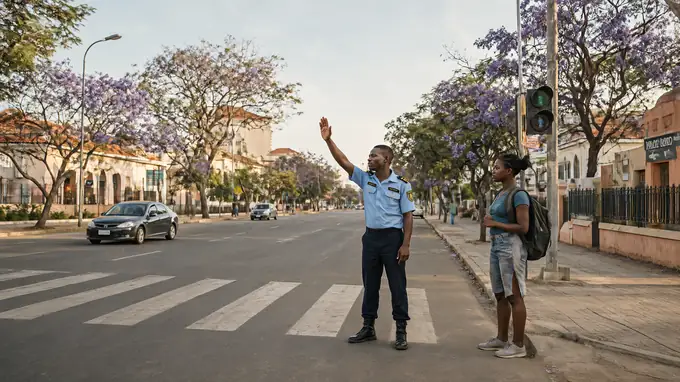
A priority vehicle may, if necessary, disregard rules and signs, but must always obey the officers' signals.
What the Code says (art. 15, n.º 1)
«podem, se necessário, não observar as regras e os sinais de trânsito, com a excepção dos sinais dos agentes reguladores de trânsito.» (Portuguese original)
The rule
At a red traffic light or a STOP sign, the priority vehicle stops; then it may continue with care, without waiting for the signal to change.
What the Code says (art. 15, n.º 2)
«obrigados a suspender a sua marcha perante o sinal luminoso vermelho de regulação do trânsito ou o sinal de paragem obrigatória no cruzamento ou entroncamento, embora possam prosseguir, depois de tomadas as devidas precauções» (Portuguese original)
The rule
On a congested road, you leave a free passage on the right-hand side and move as far to the left as possible (you may use the hard shoulder, except on a motorway).
What the Code says (art. 39, n.º 2)
«devem os condutores deixar livre uma passagem do lado direito da parte da faixa de rodagem afecta ao seu sentido de circulação, chegando-se o mais possível para a esquerda» (Portuguese original)

SituationAn ambulance on an urgent mission, with its siren on, reaches a red traffic light in central Maputo.
What you doIt must halt. After taking due precautions, it may go ahead without waiting for green. art. 15, n.º 2
Remember
- Priority vehicle: urgent emergency or government motorcade, signalling its movement.
- It may ignore rules and signs, but never the officer.
- Red light or STOP: stop first, then proceed with caution.
- To make way for it: move to the left, free corridor on the right.

Check what you've learnt
2 quick questions. Choose and see straight away if you got it right.
Which signals must the driver of a priority vehicle always obey?
Question 1See the answer
A — It may disregard rules and signs, except the officers' signals (art. 15(1)).
A priority vehicle approaches on a congested road. Where do you move?
Question 2See the answer
B — You leave a free passage on the right-hand side, moving as far to the left as possible (art. 39(2)).