
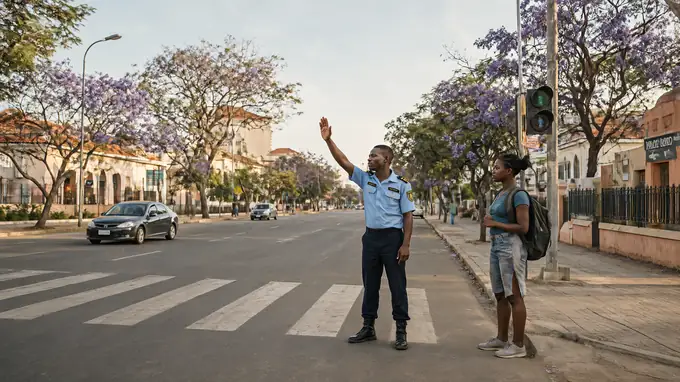
On the road you are not alone with the rules: there are people who enforce them. The best known is the Traffic Police (PT) officer, but not the only one.
When a uniformed officer signals you to stop, there is no argument: you stop. If you only stop late, the fine is lower, but there is still a fine.
The rule
Traffic is enforced by: the Traffic Police, INAV, ANE on national roads and the municipalities on municipal roads.
What the Code says (art. 10, n.º 1)
«a) À Polícia de Trânsito; b) Ao Instituto Nacional de Viação; c) À Administração Nacional de Estradas nas estradas nacionais; e d) Aos municípios nas estradas, ruas e caminhos municipais.» (Portuguese original)
The rule
A PT officer must have their name and number visible on the uniform.
What the Code says (art. 10, n.º 2)
«Os agentes da PT devem estar identificados com o nome e número visíveis sobre o uniforme» (Portuguese original)
The rule
All drivers must stop when a uniformed and identified officer signals them to.
What the Code says (art. 11, n.º 1)
«Todos os condutores de veículos ou animais são obrigados a parar, sempre que uma autoridade policial ou seus agentes, devidamente uniformizados e identificados» (Portuguese original)
The rule
With no police present, whoever commands a military convoy can also order you to stop, so the convoy can pass without interruption.
What the Code says (art. 11, n.º 2)
«as autoridades que comandem forças militares na via pública, quando se desloquem em coluna militar, na medida do necessário para que essas forças transitem sem interrupção.» (Portuguese original)
The rule
Not stopping leads to a 1,000.00 MT fine; stopping late, 500.00 MT.
What the Code says (art. 11, n.º 3)
«punida com a multa de 1000,00MT. Exceptua-se o caso de o contraventor cumprir tardiamente o sinal de paragem, em que a multa será de 500,00MT.» (Portuguese original)
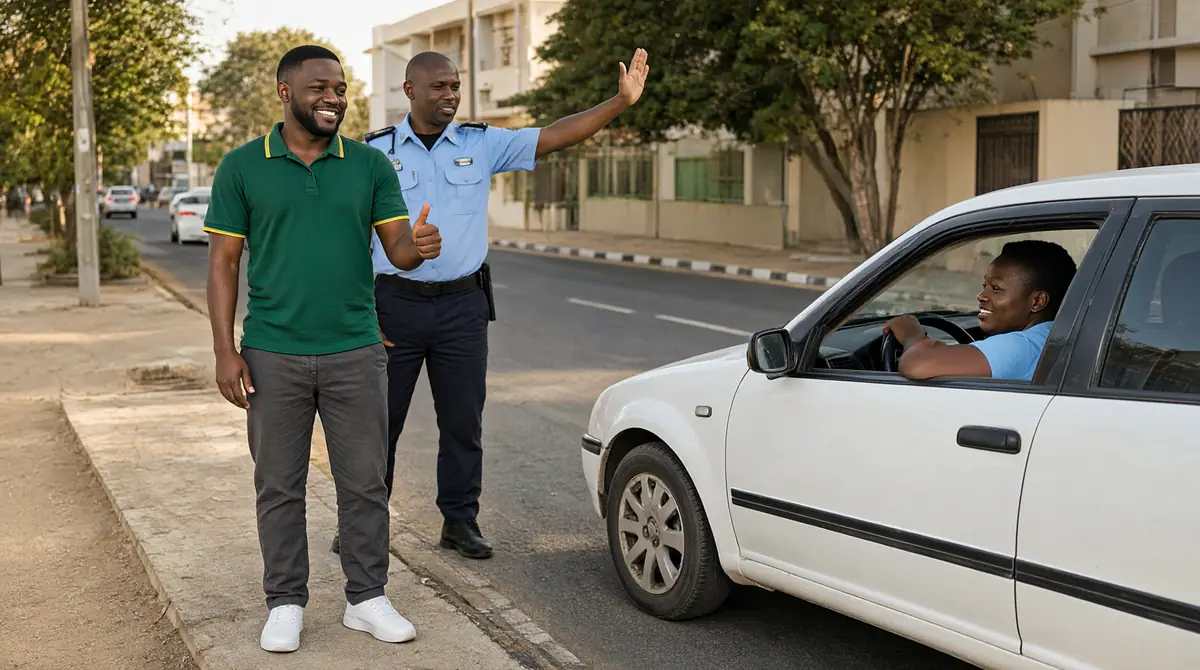
Remember
- Enforcement: PT, INAV, ANE (national roads) and municipalities.
- PT officer: name and number visible on the uniform.
- An officer's stop signal: you always stop.
- Not stopping: 1,000.00 MT. Stopping late: 500.00 MT.

Check what you've learnt
2 quick questions. Choose and see straight away if you got it right.
A uniformed and identified PT officer signals you to stop. What do you do?
Question 1See the answer
A — All drivers are obliged to stop when the officer signals them to (art. 11(1)).
What is the fine for obeying the stop signal, but late?
Question 2See the answer
B — Obeying the stop signal late is punished with 500.00 MT (art. 11(3)).