
- Study
- Practise
- Measure
- Exam at school
Review · Module 1
The road, the officers and the order of authority
All the module's quick questions, with the explanation right after each answer.

Module review
12 quick questions. Choose and see straight away if you got it right.
A five-seater car has a seating capacity of five. How many passengers can it carry besides the driver?
Question 1See the answer
A — Seating capacity includes the driver, so four seats are left (art. 1, Annex I, subparagraph (p)).
What is the part that runs alongside the carriageway and is exclusively for pedestrians called?
Question 2See the answer
B — The pavement is intended exclusively for pedestrian traffic (art. 1, Annex I, subparagraph (w)).
What is the fine for placing obstacles that hinder traffic?
Question 3See the answer
B — Placing obstacles is punished with 1,000.00 MT (art. 4(2)).
Traffic on public roads is:
Question 4See the answer
A — Traffic is free, subject to the restrictions of the Code and complementary legislation (art. 3(1)).
How far in advance, at minimum, must a planned suspension of traffic be announced?
Question 5See the answer
B — The announcement to the public is made at least three days in advance (art. 6(3)).
On a national road, who do you ask to suspend traffic?
Question 6See the answer
A — On national roads, suspension must be requested from ANE (art. 6(2)).
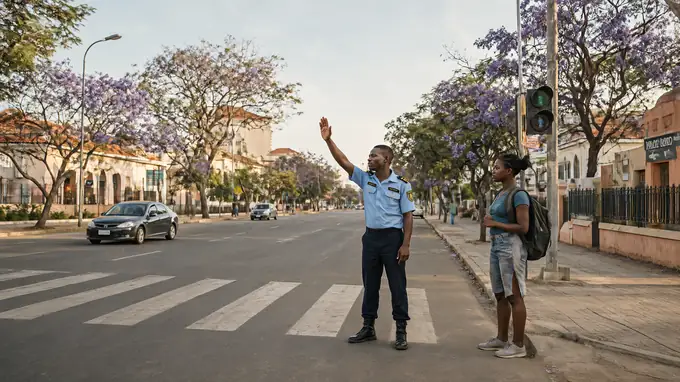
A uniformed and identified PT officer signals you to stop. What do you do?
Question 7See the answer
A — All drivers are obliged to stop when the officer signals them to (art. 11(1)).
What is the fine for obeying the stop signal, but late?
Question 8See the answer
B — Obeying the stop signal late is punished with 500.00 MT (art. 11(3)).
A vertical sign and a traffic light give different instructions. Which prevails?
Question 9See the answer
B — Light signals are above vertical signs in the hierarchy (art. 14(2)).
Which of these instructions is last in the hierarchy of signs?
Question 10See the answer
C — Road markings come last (art. 14(2), subparagraph (d)).
Which signals must the driver of a priority vehicle always obey?
Question 11See the answer
A — It may disregard rules and signs, except the officers' signals (art. 15(1)).
A priority vehicle approaches on a congested road. Where do you move?
Question 12See the answer
B — You leave a free passage on the right-hand side, moving as far to the left as possible (art. 39(2)).

Next chapter
Ready for the practice exam?
25 questions against the clock, just like on the day.
Take the exam