

Now the list is different: these are places where parking is forbidden, but a quick stop, with you at the wheel, is accepted. Think of double parking, in front of a gate, next to the fuel pumps. If you leave the car there, you are blocking someone.
The rule
Parking is forbidden where you stop properly parked cars from getting in or out (for example, double parking) and in front of entrances to properties.
What the Code says (art. 51, n.º 1)
«em todos os lugares em que impeça o acesso a veículos devidamente estacionados, a saída destes ou a ocupação de lugares vagos; c) Nos lugares por onde se faça o acesso de pessoas ou veículos a propriedades» (Portuguese original)
The rule
Parking is forbidden less than 10 m from level crossings and less than 5 m on each side of fuel stations.
What the Code says (art. 51, n.º 1)
«A menos de 10 m das passagens de nível; e) A menos de 5 m para um e outro lado dos postos de abastecimento de combustíveis» (Portuguese original)
The rule
In these places you may still halt the car for the time strictly necessary for passengers or brief loading, if you are present and ready to drive off.
What the Code says (art. 51, n.º 3)
«A proibição de estacionar não abrange a imobilização do veículo pelo tempo estritamente necessário para a entrada ou saída de passageiros ou para breves operações de carga e descarga» (Portuguese original)
The rule
Outside built-up areas, parking on the carriageway at night is forbidden.
What the Code says (art. 51, n.º 2)
«De noite, nas faixas de rodagem» (Portuguese original)
The rule
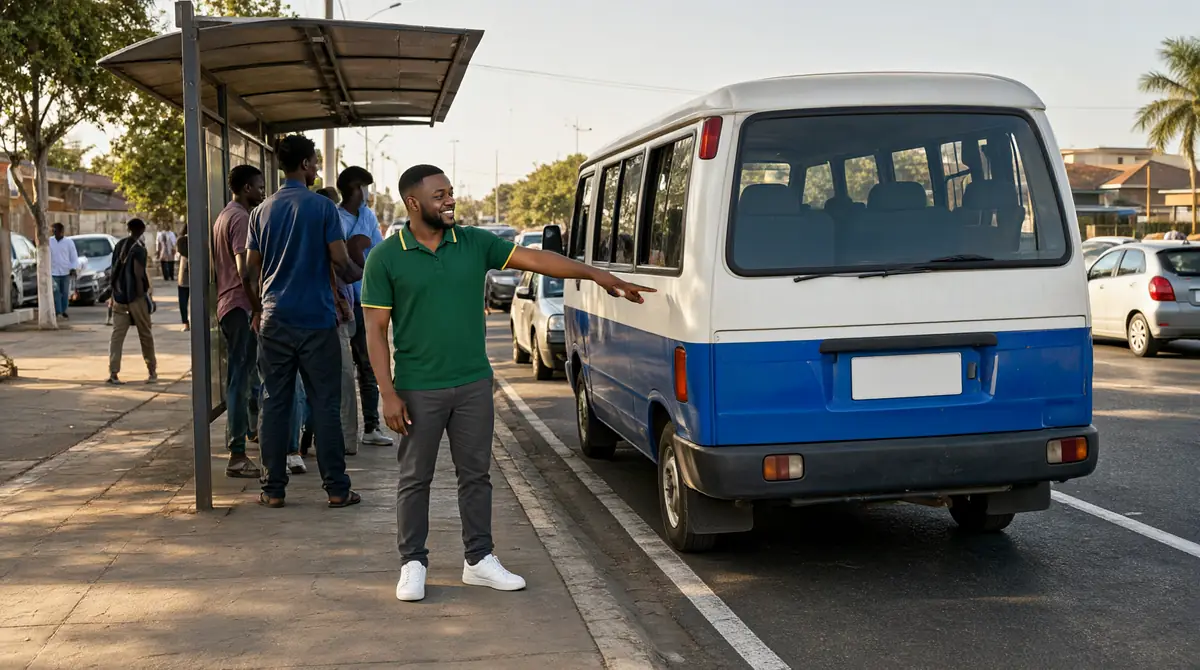
The driver of a public transport vehicle may only stop to let passengers on and off at the places intended for that; if there are none, as close as possible to the edge of the carriageway.
What the Code says (art. 53, n.º 1)
«nos locais especialmente destinados a esse fim. 2. Caso se verifique a inexistência dos locais referidos no número anterior, a paragem deve ser feita o mais próximo possível da margem da faixa de rodagem» (Portuguese original)
Remember
- No double parking and no parking in front of gates and entrances.
- 10 m from level crossings; 5 m on each side of fuel pumps.
- Outside built-up areas: never park on the carriageway at night.
- A quick stop with you present and ready to drive off is still allowed.
- Chapas and buses stop at the proper places or, if there are none, close to the edge.

Check what you've learnt
2 quick questions. Choose and see straight away if you got it right.
You are on a street and need to leave the car to go to the pharmacy. Can you leave it 3 m from a fuel pump?
Question 1See the answer
B — Parking is forbidden less than 5 m from fuel stations (art. 51(1)(e)).
On a road with no marked stop, where should the chapa stop to drop off passengers?
Question 2See the answer
B — Without proper places, the stop is made as close as possible to the edge (art. 53(2)).