
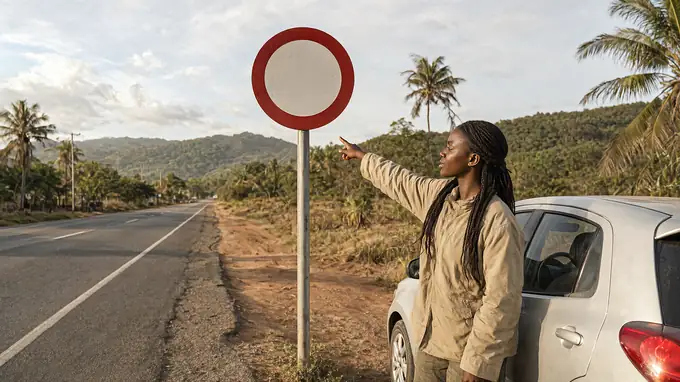
Imagine you are driving from Maputo to Xai-Xai on the EN1. The sign shows a maximum number, but the Code asks more of you than obeying the sign: it asks you to think.
The right speed depends on your vehicle (a loaded car does not brake like an empty one), the road (potholes, sand, rain), how you are (tired, nervous, sleepy) and the traffic around you. The aim is simple: nobody may be put in danger and the traffic must not be held up because of you.
The rule
Always adjust your speed to the vehicle, the road, your physical and mental state and how heavy the traffic is.
What the Code says (art. 29, n.º 1)
«Os condutores devem regular a velocidade dos veículos de modo que, atendendo às características destes, às condições da via, ao estado físico e psicológico do condutor, à intensidade do trânsito» (Portuguese original)
The rule
Speed is excessive when you can no longer stop within the clear space you can see ahead of you — or when you exceed the legal limit.
What the Code says (art. 30, n.º 1)
«Considera-se excessiva a velocidade, sempre que o condutor não possa fazer parar o veículo no espaço livre visível à sua frente, ou exceda os limites de velocidade fixados nos termos legais.» (Portuguese original)

The rule
You do not brake suddenly without checking whether that endangers whoever is behind you, unless there is imminent danger.
What the Code says (art. 29, n.º 2)
«Salvo em caso de perigo iminente, o condutor não deve diminuir subitamente a velocidade do veículo sem previamente se certificar de que daí não resulta perigo» (Portuguese original)
The rule
Driving too slowly is also forbidden when it holds others up for no reason.
What the Code says (art. 31, n.º 1)
«os veículos automóveis não devem transitar em marcha cuja lentidão cause embaraço injustificado aos restantes utentes da via.» (Portuguese original)
SituationYou are driving to Namaacha early in the morning in thick fog. The road allows 100, you are doing 60, but you can only see about 30 metres ahead.
What you doYour 60 is already excessive speed: with so little visibility you cannot stop within the clear space you can see. Slow down until you are sure you can stop in time. art. 30, n.º 1
Remember
- The sign gives the maximum, not the right speed.
- Excessive = you cannot stop within the visible clear space, or you exceed the limit.
- Do not brake suddenly without looking behind (except in imminent danger).
- Slowness that holds others up for no reason is also an offence.

Check what you've learnt
2 quick questions. Choose and see straight away if you got it right.
You are doing 50 km/h on a road with a 100 limit, at night, in heavy rain, and you can only see 20 metres ahead. You cannot stop within that space. Your speed is…
Question 1See the answer
A — It is excessive whenever you cannot stop within the clear space visible ahead of you (art. 30(1)).
When may you suddenly reduce speed without first checking whether it causes danger to whoever is behind?
Question 2See the answer
B — Only in the case of imminent danger (art. 29(2)).