
- Study
- Practise
- Measure
- Exam at school
Review · Module 10
The driver: alcohol, seat belt and mobile phone
All the module's quick questions, with the explanation right after each answer.

Module review
10 quick questions. Choose and see straight away if you got it right.
Tomás, a private driver, takes the breath test and shows 0.3 mg/l. In the eyes of the law, he is:
Question 1See the answer
A — From 0.3 mg/l in exhaled air (equal or higher) the driver is considered under the influence (art. 81(3)).
What alcohol level is permitted for someone driving dangerous goods transport, on duty?
Question 2See the answer
B — On public service or dangerous goods duty, the level is 0.0 mg/l (art. 81(4)).
After a positive breath test, for how long are you barred from driving?
Question 3See the answer
B — The ban lasts twelve hours, unless you prove before then that you are no longer under the influence (art. 83(1)).
Lúcia had a positive test and wants a counter-test. Who chooses how the counter-test is done?
Question 4See the answer
B — The counter-test is done according to the wishes of the person being tested: a new test or a blood test (art. 82(3)).
Driving under the influence of alcohol is a:
Question 5See the answer
C — Driving under the influence of alcohol or drugs is on the list of serious offences (art. 147(1), subparagraph (a)).
Sérgio was caught driving with alcohol for the first time. What driving ban applies to him?
Question 6See the answer
B — Serious offence, first time: a one-year ban (art. 148(3)).
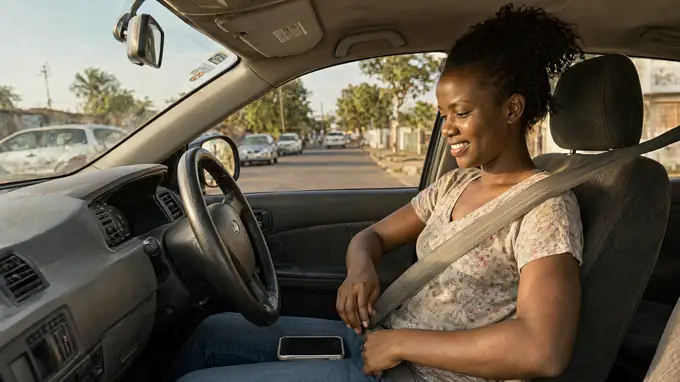
On a journey, who must wear a seat belt in the car?
Question 7See the answer
C — The driver and the passengers carried in motor vehicles are obliged to wear a seat belt (art. 87(1)).
Joana, aged 7, is travelling in a car with seat belts. How must she travel?
Question 8See the answer
B — Under 12: an approved, suitable child restraint (art. 87(4)).
While driving, which of these ways of using a mobile phone is allowed?
Question 9See the answer
B — Only an earpiece or hands-free whose use does not involve continuous handling is allowed (art. 89(2)).
Paulo has an ordinary licence and wants to do paid transport with his car. The law:
Question 10See the answer
B — The provision of paid services is only permitted to holders of a professional driver's licence (art. 88(1)).

Next chapter
Ready for the practice exam?
25 questions against the clock, just like on the day.
Take the exam