
- Study
- Practise
- Measure
- Exam at school
Review · Module 8
Lights, breakdowns and visibility
All the module's quick questions, with the explanation right after each answer.

Module review
10 quick questions. Choose and see straight away if you got it right.
How far do dipped headlights reach?
Question 1See the answer
A — The passing light lights up the road ahead up to 30 m (art. 60(1)(b)).
Which white light may face backwards?
Question 2See the answer
B — The reversing light and the number plate light are exceptions (art. 59(2)(a)).
At night, on a dark road, a car approaches from the opposite direction. Which light do you use?
Question 3See the answer
B — When passing other vehicles you use dipped headlights (art. 61(1)(b)).
When is visibility considered insufficient?
Question 4See the answer
A — Not being able to see the carriageway across its full width over a distance of at least 50 m (Article 28).
Your car's lights fail on a motorway. What do you do?
Question 5See the answer
B — It requires the vehicle to be halted immediately off the carriageway (art. 62(3)).
Your car is being towed and the hazard lights do not work. Which lights do you use?
Question 6See the answer
B — If the hazard lights cannot be used, the position lights are used (art. 63(4)).
Your car has broken down and you cannot park it. Where do you leave it?
Question 7See the answer
B — Remove the vehicle from the carriageway or bring it as close as possible to the left edge (art. 90(1)).
While you change a tyre on the hard shoulder, where should your passengers be?
Question 8See the answer
B — Anyone not involved in marking, removing or repairing must not remain on the carriageway (art. 90(4)).
What is the minimum distance from the car at which you place the warning triangle?
Question 9See the answer
B — At a distance never less than 30 m, in front and behind (art. 91(3)).
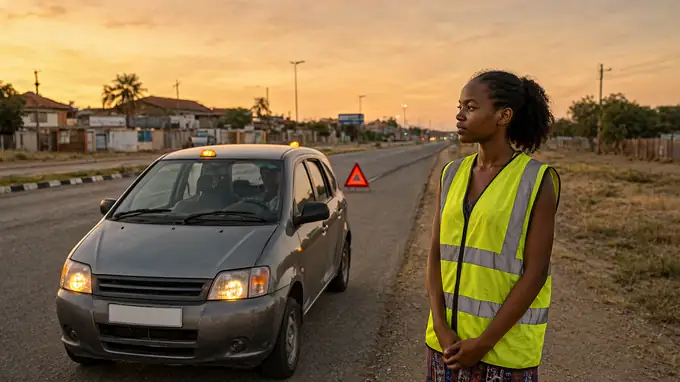
Who must wear the reflective vest?
Question 10See the answer
B — Whoever places the sign, repairs the vehicle or removes the load must use the vest (art. 91(5)).

Next chapter
Ready for the practice exam?
25 questions against the clock, just like on the day.
Take the exam